
Vicky Iovinella
RAG & Knowledge Base
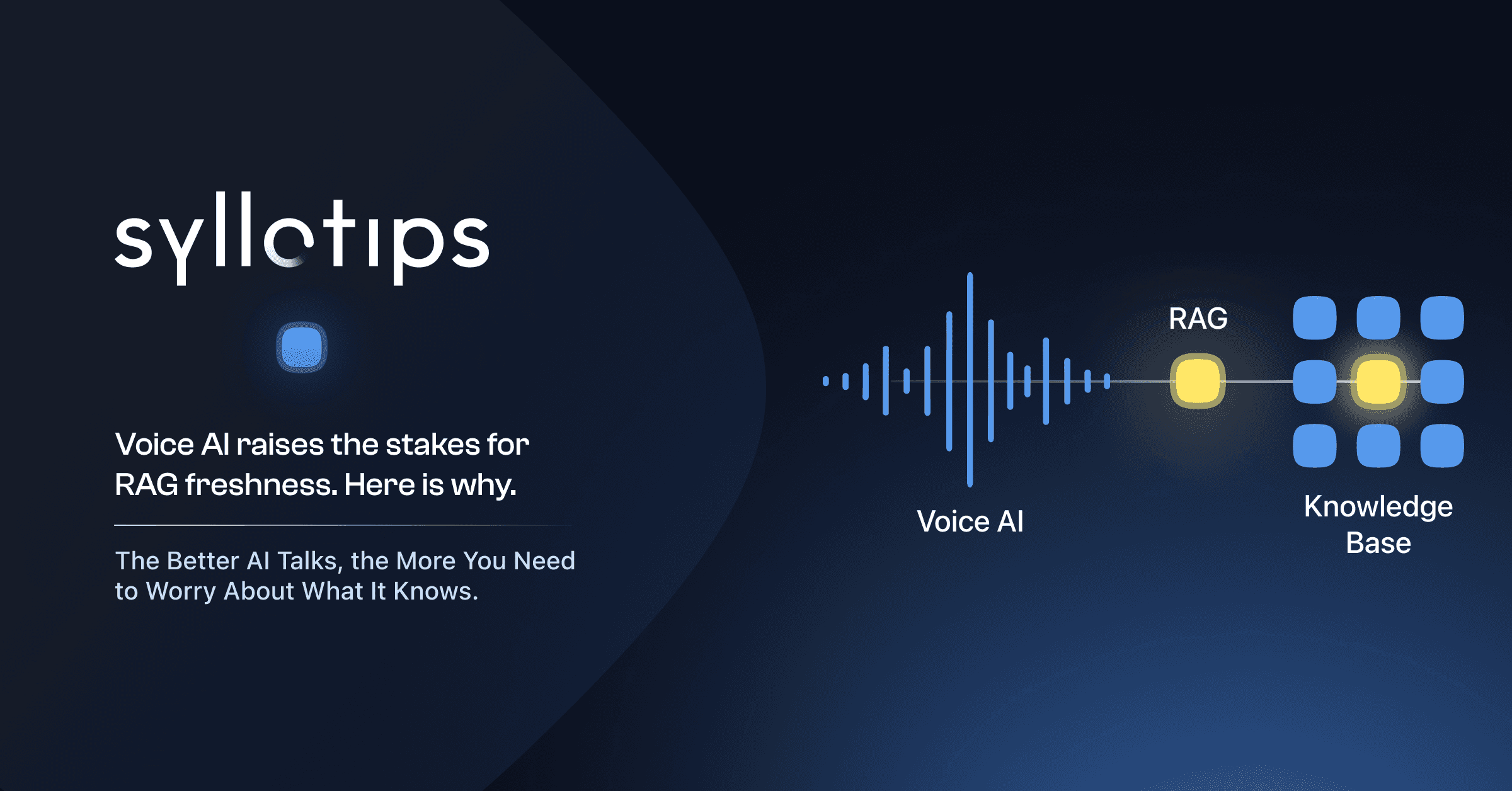
The Better AI Talks, the More You Need to Worry About What It Knows.
Full-Duplex Voice AI: What GPT-Live Changes and What It Doesn't.
OpenAI recently launched GPT-Live: a full-duplex voice model that can listen and speak simultaneously, offer real-time acknowledgments mid-conversation, and delegate complex tasks to frontier models in the background while keeping the exchange flowing. The result is a conversational experience that feels significantly more like talking to a person than anything that came before it.
That is a genuine advancement. But is it a progression or a trap?
Previous voice systems processed speech sequentially: listen, then respond, then listen again. Full-duplex changes the model fundamentally. GPT-Live processes input continuously while generating output, deciding when to speak, pause, or acknowledge many times per second. Combined with the ability to delegate knowledge-intensive tasks to more capable models running silently in the background, the result is an assistant that can hold a flowing conversation while handling substantive work simultaneously.
For consumer use, this matters enormously. For enterprise deployment, it raises a different set of questions.
The Fluency Paradox: Why More Natural AI Means More Invisible Failures.
A 2026 technical report from Bigspin AI and Stanford University analyzed 27,000 transcripts of real human-AI interactions and identified two fundamentally different ways people engage with AI.
Fluent users adopt an augmentative stance: they iterate, push back, question outputs, and redirect when something goes wrong. 93% of high-fluency user interactions in the dataset are classified as augmentative. The majority of users, by contrast, are delegative: they passively accept what the AI produces, and their failures remain invisible. The conversation ends, the user walks away with wrong information, and no signal was ever raised.
The researchers identify the dominant invisible failure pattern as the confidence trap: the AI presents incorrect information with unwarranted certainty, the user accepts it without challenge, and the interaction looks successful to everyone involved. The AI sounds authoritative. The user seems satisfied. The damage is done silently.
For enterprise deployments, this is the critical point. Most enterprise users are not high-fluency AI users: they are operators, service agents, and back-office staff using AI as a tool embedded in their daily work, and delegative behavior is the norm, not the exception.
The Confidence Gap: When Sound and Accuracy Diverge.
In text-based AI, a user can pause, re-read, and second-guess.
In voice AI, the experience is linear and immediate: the wrong answer arrives with the same warmth and fluency as the right one, because vocal cues such as tone, cadence, rhythm, acknowledgment are generated by the model independently of content accuracy. This is the real dangerous side of the confidence trap, what we can call the confidence gap: the divergence between how certain an AI system sounds and how accurate its underlying knowledge actually is.
In agentic contexts, where AI agents have access to files, systems, calendars, and the ability to execute tasks autonomously, this invisibility becomes an operational problem. The agent's actions are only as reliable as the knowledge it retrieves, and in most enterprise deployments that knowledge comes from a RAG system. But RAG systems degrade: procedures change, policies are updated, regulations are revised, and the AI does not know. It retrieves the last version it was given and acts on it with full confidence.
The shift from conversational AI to actional AI means that wrong answers no longer just mislead: they act. An agent that misreads an outdated procedure and executes it does not produce a bad conversation. It produces a bad outcome. The confidence gap stops being a UX issue and becomes a liability, and the more autonomous the agent, the larger the liability.
"When AI sounds more human, users have fewer signals to detect when it is wrong. That is not a feature gap: it is a knowledge gap."
Enterprise RAG Accuracy: Why Knowledge Base Freshness Is the Real Problem.
Most enterprise AI systems ground their responses in a knowledge base through retrieval: a mechanism that surfaces relevant documents or procedures before generating an answer. The quality of the response depends entirely on what gets retrieved, and what gets retrieved depends on what is in the knowledge base.
When RAG content is outdated and a wrong or missing answer surfaces, the typical response is an escalation to IT, a ticket, and an attempt to upload updated content to the source folder as quickly as possible. In practice, quickly means months. And by the time the revised procedure or updated information goes live, it is often already out of date again.
The people who know when knowledge is outdated are domain experts: the compliance officer who saw the regulation change, the product manager who deprecated the feature, the field technician who found the workaround. In most RAG deployments, these people are not in the loop.
Their knowledge is not captured until it surfaces as a failure. Yet they are the only ones who can respond in time, with the right expertise, updating the knowledge base in minutes rather than months.
Confidence gap
The divergence between how certain an AI system sounds and how accurate its underlying knowledge actually is.
Judgment Infrastructure: How to Keep Enterprise AI Knowledge Current.
According to a June 2026 Harvard Business Review analysis by Jen Stave, Ryan Kurt, and John Winsor, as AI agents take on more complex work, the key constraint is no longer access to technology: it is an organisation's ability to make its decision-making processes explicit. The critical judgments that govern risk, exceptions, escalation, and customer treatment have traditionally existed as tacit knowledge embedded in experienced employees. Organisations that succeed at AI, the authors argue, will build judgment infrastructure: institutional knowledge made portable, consistent, and scalable.
The Syllotips Continuous Improvement Layer is precisely this infrastructure. Every time the system produces a response, it cannot ground with confidence; it flags the gap and routes it to the right Subject Matter Expert. That correction does not fix one conversation. It enters the knowledge base, propagates in real time, and prevents the same gap from producing the same wrong answer in the next interaction, whether that interaction is text, voice, or an autonomous agent executing a task in the background.
Judgment infrastructure only gets better if someone is deliberately building it. The interface gets more natural every month. The knowledge behind it only keeps up if someone is actively maintaining it, and that someone is never the AI.
RAG accuracy
RAG freshness
Voice AI enterprise
Knowledge base AI
Fluency paradox AI
Enterprise AI knowledge management
Vicky Iovinella
Writer
Ready to gather your experts’ know-how?
See how Syllotips can help your team deliver expert-level support at scale.